

Do you know Record, the zine project Daido Moriyama began back in 1972?
(Of course, back then, no one was calling it a “zine.”)
In an interview, Moriyama described Record like this:
“I wanted people to see fragments of my real, everyday life. That’s why I started Record. It’s different from a photobook where you carefully select and organize images. I print everything I shoot, one by one, and put it all into a single volume. And I try to print it as quickly as possible and show it to people.”
Over the past two years, I’ve made six zines of my own.
Each one had a clear theme, and naturally, I selected photos that fit those themes.
But as I kept making zines, I started to notice something:
there are always photos that don’t make it in.
Not because they’re bad photos, but simply because they don’t fit the theme.
There are so many images that never see the light of day for that reason alone.

I want to show this series too, but it’s still not out anywhere.
The same goes for my darkroom prints. I spend a lot of time printing at home, but many of those prints end up sleeping quietly in a box, never being shown.
I wanted to share those unseen photos and prints more freely.
That feeling pushed me to start a new zine project—one of my biggest projects this year.
In this newsletter, I want to introduce that new project.
Table of Contents
“Street” Is an Undefined Concept
Last month, I returned from traveling in Taiwan and China, and almost immediately jumped into the Tokyo Streets X exhibition that weekend. Before I knew it, the year was wrapping up, and the holidays were filled with visits to see my mother, who lives alone in Hokkaido. Things got busy, and I took a short break from the newsletter.
From this week on, I’ll be back to sending it out every Tuesday. I hope you’ll stick with me.
To talk about this new zine project, I need to start with the idea of “street.”

I’ve been shooting street photography for many years, but the photos I take aren’t always literally on the street.
Everyone defines street photography differently, but for me, “street” (including street culture) is where new movements emerge—places filled with something that hasn’t yet been categorized or named.
In that sense, street photography is, broadly speaking, an undefined genre.
And that’s exactly what draws me to it.
When zines first emerged as a medium for minority voices, the people creating them were often undefined too—people who didn’t fit neatly into society’s existing categories.
I’ve always preferred music that’s rough but deeply resonant over polished, mass-oriented tracks. The same goes for street photography. Even if it doesn’t appeal to everyone, I love photographing the lives of people in Shinjuku—people who are just trying to survive, people who are still “nobody.”
Finished Photos Sometimes Contain Lies
Being undefined. Being unfinished.
That’s one of the core ideas behind my photography.
If I were to make a hardcover book, the photos inside would become “finished” in a certain sense. A finished photobook fixes the meaning of images in place.
But a medium like a zine—something you put out as-is, unfinished—keeps photos from being locked down.

Think of the difference between a rapper’s mixtape and a fully produced studio album.
A zine is a mixtape: raw, rough, unfinished, driven by pure initial impulse.
Photos in that unfinished state are dense with passion, and they haven’t yet been contaminated by the photographer’s excuses or explanations. Once you try to polish something into a “final form,” you start adding reasons after the fact—and that’s where lies creep in.
I want to deliver photos that are still alive.
Not frozen food, but freshly made sushi.
That’s why I make zines.
And as someone who documents life in the city—the smell of people, scattered trash, heat, tension—I believe zines are the best medium to deliver those things while they’re still fresh.
Chasing Freshness
Looking back, I think I may have polished my previous zines a little too much.
Paper choices, tracing paper experiments—I put a lot of care into making them beautiful.
But when you chase quality too hard, a zine can easily turn into nothing more than a self-published book.
Everyone defines “zine” differently, but for me, the key difference between a book and a zine is whether it enters mainstream distribution.
If you can’t find it in a normal bookstore, that’s where zines really live. The dopest stuff always does.
So this time, instead of prioritizing refinement, I decided to focus on regular publication—a zine that doesn’t carefully select and polish, but simply shows what happened that month. Something closer to Moriyama’s Record. Something fresh.
That’s why I chose the newspaper format, and why this newspaper-style zine will be my biggest project of 2026.
This Zine Is My Creative Notebook
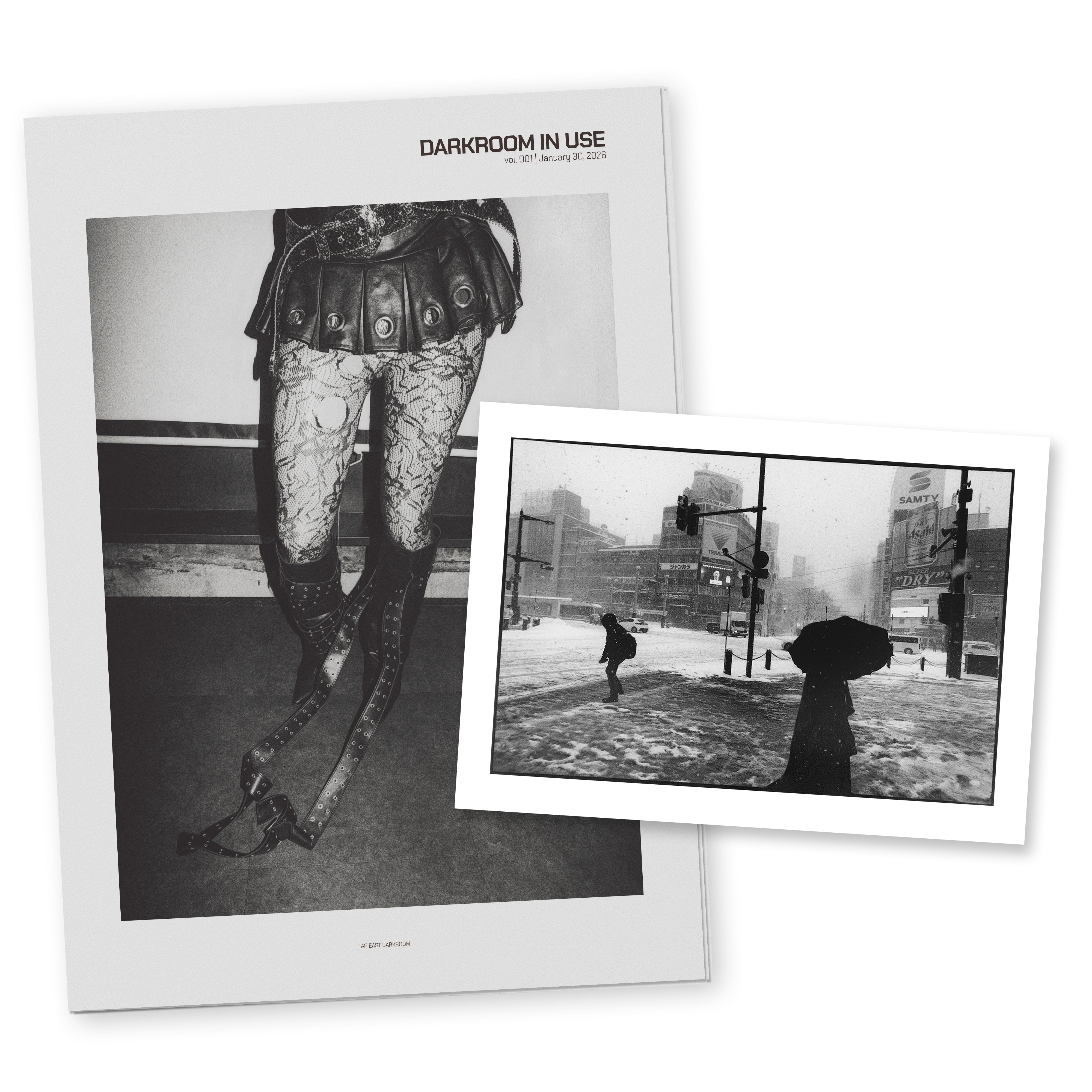
Each issue will be 24 pages. Alongside my own photos, I’ll feature one photographer every month. For the very first issue, I’m featuring Taiwanese photographer Yeh Che-Yeh.
(He hasn’t used Instagram since his account was banned, so chances to see his work online are extremely limited—which makes featuring photographers like him even more exciting.)
I’ll also include my darkroom printing process, film development notes, and stories from shooting. This isn’t just a zine that lines up photos—it’s closer to a creative notebook, showing how I work.
Every issue will also come with one of my darkroom prints as a gift.
This month’s print was shot in Hokkaido and printed on Ilford 5×7” fiber paper.
(I feel a little awkward saying this myself, but you won’t find my fiber prints at this price anywhere else.)

I’ve also prepared an annual subscription plan. Subscribers will receive a framed print in the first month. The mat is custom-made to complement my prints, and the frame is designed so you can swap in each month’s new print as it arrives.
Annual subscribers will also receive a shout-out as supporters in each future issue (name or handle optional). More details will be shared by email.
Pre-orders for the first issue close on January 31
To manage shipping, this monthly zine will be available only during a limited order window each month. Once the window closes, it won’t be available for purchase.
For this first issue, orders are open from today until January 31.
(Shipping is planned for around February 10.)
To reduce shipping costs for international readers, this monthly zine will be sent as untracked letter mail. I’ll personally stamp and send each envelope.
It’s the beginning of a small adventure—monthly zines and prints traveling from Tokyo to the world.
As you know, FED also supports photographers by purchasing their photobooks and zines upfront, reducing inventory risk and helping fund their creative work—including the recent photobooks by Yu Chang.
Sales from this monthly zine will allow FED to support even more photographers, so if you’d like to support what we’re building, I’d truly appreciate it.
Thank you, everyone. You’re the best.
See you next week.
🦖 Come hang out with me on Instagram → @_nuts.tokyo_
🪐 New videos on zines & photography up on YouTube
🧃 Curious about Japanese and Asian zines? Visit FAR EAST DARKROOM.

